Showing posts with label bulolo mp. Show all posts

Sunday, November 14, 2010

Bulolo - my strategy to drive the district forward to bring prosperity to my people


Hon Sam Basil MP
Member for Bulolo
Paper presented to the Lowy Institute for International Policy on Tackling Poverty in Papua New Guinea, Sydney, 14th May 2009

Distinguished Guests, Friends of Papua New Guinea, Ladies and Gentlemen. I am very grateful to the Lowy Institute; Care Australia and the Australian National University for inviting me to present my view in Sydney today on how to tackle poverty in Papua New Guinea and especially the practical steps I am taking in my electorate of Bulolo.

Let me start off by giving you a bit of background into Bulolo. My people are simple subsistence farmers and like the majority of Papua New Guineans in rural areas they live on the poverty borderline. This is despite the fact that Bulolo sits on some of the richest mineral deposits in the world and the electorate has over the last six years experienced a massive increase of foreign investment into the District. This may be good news for the mining companies and it means more tax revenue goes to the Government coffers. However, I am very disappointed that the mineral sector has contributed very little to the social and economic development of Bulolo even though extensive exploration and mining has taken place there for decades. In the 1920’s, Bulolo District was the most advanced and prosperous region in all of PNG. The district had good access to road networks; very good airline service; top quality health service; electricity and telephone services. Today, Bulolo still carries the ugly scars of the huge environmental damage left behind by the early mining pioneers. 

They cared very little for the welfare and well being of our people. They had no long-term developmental plans for the townships of Wau and Bulolo but were more interested in making huge profits and transferring them to their bank accounts in Australia.

I am a realist and know that nothing will change overnight unless I take the leadership to articulate and develop long-term strategic plans to address the social and economic hardship facing my people and electorate. I can say that Bulolo does have a high rate of child malnutrition, maternal mortality, child mortality, tuberculosis and an increasing number of HIV/AIDS cases. Our health centers; clinics; schools in Bulolo, Wau and sub-districts are crumbling under the weight of our people demanding better services. 

Furthermore, there are shortages of doctors, health workers and teachers. Our people are desperate for help and they are drowning in a sea of despair and are gasping for air. Our aging road system that connects the rural populace to Wau, Bulolo, Mumeng and Lae City are in critical need of repair and maintenance as it is the only lifeline for bringing social and economic development to my people. I can stand here until the sun sets and criticize my Government and our former colonial master, Australia, for their past misdeeds, but what good would that do for my people? 

Since I got elected into Parliament, I have made it a priority for the district to invest 80 percent of our development budget each year in basic infrastructure. Once our Joint District Budget Planning Committee had set out its priorities, we then established the Bulolo District Road Maintenance Program (BDRMP).  It is designed to link into and complement the joint district and national works road maintenance programs. This program is self-funded by the district with its own equipment and road construction crew. We funded for and purchased 3 bulldozers; 1 backhoe; 4 dump trucks; a roller; an excavator; a grader and 4 tractors which will be used to clear up our rural roads that have been neglected for years and roads in the townships of Wau and Bulolo. The district pays for and employs a fulltime road crew; mechanic and manager. The purpose of the BDRMP is not a political stunt but an initiative that will open opportunities for our smallholder and subsistence farmers to have access to markets.  

It is my intention to ensure that mothers with a sick child will not have to walk more than 4 hours to reach the nearest road to get to a health clinic or hospital. 

Many schools and health centers in the district have been deprived of educational materials and medical supplies because the roads are in a bad state due to incompetence and neglect by successive Government authorities over the years. 

Already we can see that the BDRMP is making a difference to the lives of the Bulolo people and reducing poverty at the district level. The BDRMP is increasing the disposal income of our rural people and raising their level of confidence to participate and contribute to the social and economic development of their community. For instance, PMV’s are now traveling into some of the most remote villages and transporting down to Lae garden vegetables and coffee for farmers to sell whereas a couple of years ago their crop will go to waste as they had no access because their road had been washed away by floods or been left to the elements because of lack of maintenance. Many woman farmers have expressed their happiness to me that now they can sell their vegetables and save enough for their children’s education as well small scale alluvial miners having their buyers at their doorsteps.

In this paper I will also highlight some of the other programs currently under implementation and initiated by my Joint District Priority & Budget Planning Committee (JDP&BPC) of which I am chairman:

                        A. Bulolo District Road Maintenance Program (BDRMP)

Responsibilities; Road building, culverting and general maintenances. The program has a contracted manager with all operators and drivers on an annual budget funding.

                        B. Bulolo District Water Supply Program (BDWSP)

Responsibilities; Delivering & Installation of new water projects and maintenances to existing systems.

                        C. Bulolo District Rural Electrification Program (BDREP)

Responsibilities; Working in Partnership with PNG Power Limited in HV Transmission Lines plus installations of MSK units to rural houses. 
                        D. Bulolo District Building & Maintenance Program (BDBMP)

Responsibilities; This program has a set of 3 x Units of carpenters consisting carpenters, brick layers and plumbers with provision of engaging villagers for its building programs. This program helps build new classrooms, health centers and other community building requirements as the costs of all workers are being budgeted and paid including equipments and machineries.

                        E. Bulolo District Foot Bridge Program (BDBFP)

Responsibilities; Building foot bridges under the supervision of a program manager equipped with all equipments and machineries.

                        F. Bulolo District Mobile Health Program (BDMHP)

Responsibilities; Delivering of health extension services by treating villagers by road due to non existence of drug supplies in the rural aid posts. A budget of K10,000.00 per month is made available for drug purchases plus the contract costs of the HEO, Driver and logistical support of this mobile program.
 
                        G. Bulolo District Rural Communication Program (BDRCP)

Responsibilities; This particular program helps Telikom with extra funding to run telephone aerial cables kilometers apart from the main installations. 

These programs are basically designed as a Parallel System of Delivery due to the non existence of the normal government service delivery mechanisms. For example why build an aid post when there are no drugs to be delivered by the national government? As an elected Member of Parliament I cannot sit, wait and hear my constituents complain about lack of services all the time.

A key feature and a very important component of one of our programs are targeted specifically at woman. Our District has recently invested K80,000.00 into honey bee backyard farming. We have successfully rolled out 50% of the program with the other half to commence next month. I anticipate that when this program is completed there will be 60 woman bee hive farmers. We
estimate that these farmers will make approximately K18,000.00 per annum in revenue. The current market of honey is at K10.00 per kilogram so it opens up another opportunity for our woman to generate their own income to support their family.  

The district will evaluate and monitor this program and will provide regular funding every year to ensure its sustainability.

Furthermore, our district has provided K10,000.00 in a seed distribution program to assist woman to grow commercial crops. In this program, the district provides seeds at no cost to woman in the villages so that they can grow a range of quality fruit and vegetables. Once the produce are ready, I have made an arrangement where the woman farmers will sell their fresh fruit and  vegetables directly to Nationwide Catering Services which is contracted to do the catering for the Hidden Valley Gold Mine and Wafi Mine, both operations located in my electorate. This initiative is a joint collaboration between NCS and my JDP & BPC. This program is designed in a way to bring the market directly to the doorstep of our woman folk. We will support and sustain this program by providing K10,000.00 every six month for seed purchases and distribution.

Woman of Bulolo are the backbone and driving force behind the economic and social development of the district and I will ensure that they will get 120 percent support (not 100 percent!) in our development budget every year.

Also during the NARI expo last week my district has also paid K300,000.00 to the Department of Agriculture & Livestock in Erap to make available 180 cows, 180 goats, 8 buffalo, 6000 ducklings and drinkers for 667 farmers and 20,000 fingerlings of super tilapia with additional K7000.00 to the Morobe Fisheries inland farming program for training workshop which will commence next week.
A further K30,000.00 will be made available NARI for 300 farmers to attend classes and sharpen their skills in agriculture with introduction of rabbits included in their programs. There are a number of other development type programs that my district planners are working on. Once we are able to set our priorities, we will roll them out in 2010.

The Government has neglected the people of Bulolo for more than 20 years. Since the beginning of the 1900’s, foreign investors have
ripped the heart and soul out of my people’s land in mining for gold and yet Bulolo still is and remain one of the least developed electorates in Papua New Guinea. 

There is a wide gap between the haves in Port Moresby and the have-not’s in the rural areas. Despite being independent for more than 35 years, our people still do not have access to basic services such as roads, clean water, proper sanitation, communication and electricity. Our leaders have an obligation to invest in meaningfully social and economic programs that will help alleviate poverty

Investment into appropriate technologies to process cash crops currently available such as producing ground coffee to replace instant coffee, village level production of raw sugar to replace refined sugar, goat/cow milking techniques and know how to replace condensed/dry milk, rice production and processing to replace imported rice from the trade store shelves, cultivating and curing tobacco products to replace cigarettes, introducing the craftsmanship of jewellary to convert alluvial gold to jewels, coffee pulping machines, introduction of walkabout sawmill to produce timber locally to replace hardware timbers are some examples of job creation that will also protect the micro economy to sustain itself and grow.

In conclusion, I have a message for our donor friends. I believe now is the time particularly for policy makers in Australia and Papua New Guinea to undertake a major overhaul and review of development aid program in Papua New Guinea. I am hearing the message from my people very loud and clear. They are frustrated and showing contempt in the Government system because they can see that their lives in the village are not improving but they can see that they are slipping further and further into poverty. The people of Papua New Guinea need fresh air to breathe after decades of neglect and deprivation. This is not political grand standing, but a reality for my people. It is my hope that the Government, businesses, foreign investors and donors can reach out to these marginalized communities and work in a collaborative manner so that together we can bring improvement and hope to their lives and aspirations for this current generation and our children’s future.

Thank you

Sunday, November 7, 2010

Arrows of Eldorado – how the Wau-Bulolo gold rush all began

By MALUM NALU

It’s a sense of déjà vu to be in the historic mining towns of Wau and Bulolo in the Morobe province right now.
Merri Creek near junction with Edie Creek,1928
With the Hidden Valley gold mine project having been officially commissioned in September this year, exploration work at Wafi going ahead as scheduled, and PNG Forest Products continuing to supply its products to major projects around Papua New Guinea, things are certainly looking very good.
This is despite the dark cloud of the ethnic conflict between the local people and Sepik settlers hovering over,
History is indeed being rewritten in this Eldorado of PNG, which laid the foundation for today’s modern economy – and that of neighbouring Australia as well.
Harry Darby (seated) with pans of gold,1928
 Wau and Bulolo made miners from all over the world very rich men.
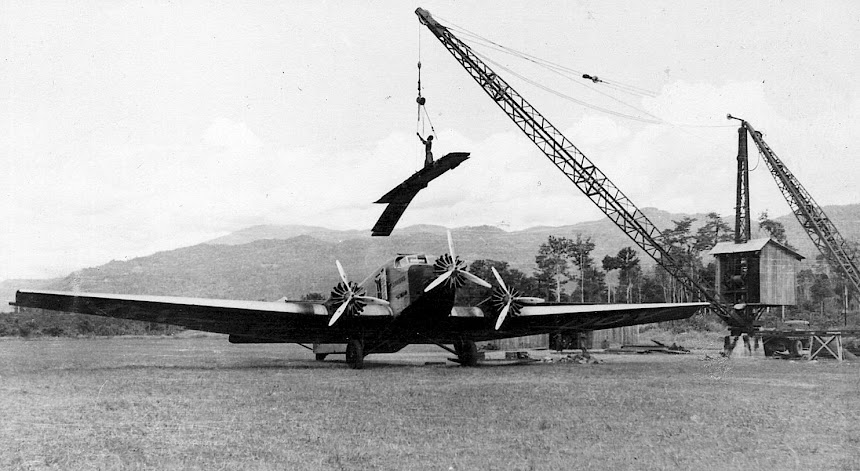
PNG Forest Products evolved from Bulolo Gold Dredging Limited that commenced operations in large-scale alluvial mining in the late 1920’s.
The Bulolo region was at the time one of the largest gold fields in the world.
A total of seven dredges scoured the valley floor, dredging thousands of tonnes of high grade gold-bearing ore.
How the Wau-Bulolo gold rush all began is a classic in itself and to go into every detail would fill many pages.
In the early part of last century, it was almost as if bowmen were guarding the gold that lay on the edge of their country more richly than anywhere else in the whole Pacific.
Fierce fighters lived along the Markham, the big river flowing into the Huon Gulf.
The Markham’s big tributary we call the Watut – and that was the river that led to the new gold, the new Eldorado.
The story is that Watut gold was discovered by an Austrian prospector, Wilhelm Dammkohler, and that he was killed by the Kukukukus on Sept 12, 1909, while prospecting with a companion Rudolph Oldorp
Canadian prospector Arthur Darling, in 1910, apparently did go up the Watut and into its tributary, the Bulolo.
There he found gold, rich gold
However, Darling and his team of Orokaiva boys were attacked by the local tribemen and had to exit.
“Precisely how far Darling traveled is unknown, though many old Papuan miners believed that he discovered gold,” according to the newly-released book Not A  Poor Man’s Field.
“Later events suggest he reached Koranga Creek, a tributary of the upper Bulolo River, itself a tributary of the Watut, and close to Kukukuku territory.”
Jensen’s bridge across the Bulolo, Guinea Gold workings,1928

When Darling recovered he went across to the new Lakekamu goldfield to try to win enough gold to outfit himself again.
On the Lakekamu field Darling spent a lot of time talking and mapping and planning with William Park, who was called ‘Sharkeye’.
Darling was at Samarai preparing to go up the Waria, when he collapsed, and soon afterwards died.
He had left Sharkeye Park knowing enough.
Somewhere right up the Watut was the source of gold that coloured the sands of the lower Markham, and the way to reach it was not to go right around by the rivers but to cut in overland from the coast!                                                                                                                                                                                                                                                                                                                                                                                                                                                                                                                                                                                                                                                                                                                                                                                                                                                                                                                                                                                                                                                                                                                                                                                                                                                                                                                                                     However, it was a foreign country, and although the Governor, Hahl, the best of the German administrators, did (about 1910) actually encourage Australian prospectors to come in and apply for permits to prospect, a man still needed more gold than Sharkeye had, to outfit himself for a months-long trip.
Before he had enough gold the war with Germany came.
It was a war that ended German rule in north-east New Guinea and the Bismarck Archipelago in six weeks, with little shooting.
When the military administration ended and the Australian Mandate started, in May 1921, Sharkeye Park was already going in and out of Morobe on the New Guinea side.
Now he headed up the Francisco River, looking for a way, through a mountain range that peaks up to nearly 10,000 feet, to the rivers that flowed on the other side.
He came back sick, broke, and not knowing what to do next time…
William Park was called ‘Sharkeye’ because he had a twist or a squint in one eye.
Park was born in Dorset, England, in 1871 and had been a gold miner in the Klondyke and in Western Australian before arriving in Papua around 1905.
“He was hard-faced and in his 50s, could ‘work like a tiger’, was jungle-wise and native-wise, hated to owe a penny, had more bouts of fever that he could count, suffered from piles, had his last tooth removed by Jack Nettleton, drank anything, and although it is untrue to say that he never wore boots, he often worked without them (he died, a very rich man, in Vancouver in 1940),” writes author Colin Simpson in Plumes and Arrows.
“In 1922 he needed a partner for two good reasons: he was broke and he had lost his permit to employ native labour when he flung a whiskey bottle out of his tent and it struck a native on the head and killed him.
“He was staying with Jack Nettleton, who had a trade store on the coast and was good to Park, and who had some money and a permit to work natives.
“Park told Nettleton what he knew.
“Nettleton, an English-born rover who had been everything from a salmon-fisher in Canada to a freight-clerk in New York, by way of jobs in Seattle, in Portland (Oregon) and Idaho, had stayed on in New Guinea after being a warrant-officer in the army during the war.
“In August 1922 Park and Nettleton struck inland and crossed the heavily jungled rivers of the Kuper Range beyond which lay the Bulolo River, forking off the Watut, and more gold, fantastically more gold, than anywhere else in Papua or New Guinea,
“They found it where Koranga Creek and Edie Creek come into Bulolo – gold that was to give them each a fortune; and when they had taken all they wanted, there was enough left for the six-million-dollar company, Bulolo Gold Dredging Ltd, to win, in the 30 years following, 56 tonnes of gold, then worth 28 million pounds.”
This was October 1922 and according to new issue Australian mining ordinances no claims could be worked until April 1, 1923.
April came and soon the richest parts of the Bulolo River were locked up in leases granted to the first-comers, including Morobe district officer Cecil J. Levien.
April 1923 came, and soon the richest parts of the Bulolo River were locked up in leases granted to the first-comers, including Levien.
Late arrivals had to look elsewhere.
“This is what Bill (W.G.) Royal and Dick (R.M.) Glasson were doing in 1926, trying to find the source of the Bulolo’s gold, when they came into Edie Creek and decided to go to the head of it,” Simpson writes.
“What showed in the dishes they panned in these streams was gold in unbelievable concentration – if it was gold.
“At first glance – according to Bill Money, who was in partnership with Royal, Glasson, F. Chisholm and Joe Sloane – it looked too dark.
“The Edie gold, alloyed with silver, was heavily stained with manganese but rubbed shiny and was the real stuff of Eldorado.
“Joe Sloane said to his mate who was running his sluice box at 11.30am: ‘Y’d better clean up Bill. The bloody gold’s running outa the box’.
“That day they got 272 ounces.
“Where the Bulolo was rich big-scale dredging, this was incredibly smaller-scale sluicing.
“About six million pounds worth of gold was won from the top of Edie Creek.
“The Edie ‘Big Six’ – Bill Money, Bill Royal, Dick Glasson, Frank Chisholm, Joe Sloane and Albert Royal – all became rich men.”
More and more white miners came and, again, the late-comers had to look elsewhere.
There was gold in the Watut as well as in the Bulolo.
Where was the source of the Watut’s gold?
Men who dreamed of finding another Edie Creek began to look for it.
They began to look for it on the other side of the Watut.

Wednesday, November 3, 2010

Care centre unfit, says health chief

By RIGGO NANGAN 
 
THE Morobe provincial health adviser has warned that the Bulolo care centre may soon be condemned for health reasons, The National reports.
Dr Likei Theo said on Monday that health conditions at the centre were such that it had to be condemned.
Theo was in Bulolo last week for his health visit programmes to all the districts.
He visited the care centre and inspected the water supply systems, latrine facilities, rubbish disposal system, cooking facilities and handling, lodging facilities (tents) and addressed other social issues.
Although the centre was predominantly occupied by Sepiks, there were other people from all over the country, including West Papuans, who made up the 5,062 people living at the centre.
Theo said the water treatment system using chlorine could not be guaranteed safe because the 1,000-litre tank used to store water would dry up faster and needed to be refilled regularly.
He said the toilets were not enough to cater for the population and people tended to use the surrounding shrubs.
The tarpaulin tent were vulnerable to damage and leakage during heavy rains and falling foliage of the rain trees.
Theo said food rations were 2.5kg of rice and two 250g of tinned fish a day which was equivalent to one meal for 13 people, which, according to him, was insufficient.
“I am really concerned and we, the local health authorities, would be forced to close the centre if worse comes to worse,” he added.
He said the centre was supposed to be only “for about a month or less”, but it had gone into almost six months.
“I strongly call on the prime minister and NEC Department, health minister, national and provincial disaster offices and other concerned authorities to speed up whatever actions they are planning to help rid this situation,” Theo said.
He said that the care centre looked more “like a mini-refugee camp where the victims are awaiting their fate while countries tussle as to who will take them on board”.
He urged NGO groups, business houses and others to pitch in and help because the situation was seriously unhygienic with legal implications.
“I know a health situation (crisis) when I see one, and the case at Bulolo is no exception,” Theo said

Friday, October 29, 2010

How Sepiks ended up in Bulolo

By MALUM NALU

Exactly two years ago, in October 2008, I travelled around Bulolo with local MP Sam Basil, checking out various projects in his electorate.
Upper Watut warriors of Bulolo
At Manianda in the Upper Watut local level government, along the road to Menyamya, Wau-Bulolo mayor and long-time Sepik settler, Jack Nawie, sent a blunt warning to criminal elements that there must be “zero tolerance” of crime in these two towns.
Happier days…Wau-Bulolo mayor Jack Nawie (left) with Bulolo MP Sam Basil in Upper Watut… ‘zero tolerance’ of crime in Wau and Bulolo

In retrospect, looking back at what Nawie said that day, I can only say that he has must have had a crystal ball in hand.
I say this in light of the recent ethnic clashes in Bulolo between the local people and Sepik settlers and, to a lesser extent, that between the Watut and Biangai people last year.
Nawie said that fateful day that the two historical gold mining towns were once again experiencing a boom and mining and exploration activities and their “cowboy town” tags must be disposed of to attract more investment.
Aerial shot of a gold dredge in Bulolo. The rivers and creeks around Bulolo and Wau abound with alluvial gold
“As the manager of these towns, I will not tolerate these criminal activities anymore,” he said.
“There will be ‘zero tolerance’ of criminal activities.
“As manager of these towns, I want companies to come and invest here.
“We don’t want the ‘cowboy town’ image of Wau and Bulolo to come back and haunt us.
“We will work closely with all companies already here and those who want to come in as they are bringing services and we want to support them.
“I also want to raise the level of the two towns from urban level 2 to Urban Level 1 because of the current boom in mining and exploration.
“I will work closely with Bulolo MP Sam Basil and other LLG presidents to push for development in these two towns.”
Nawie is originally from East Sepik but, like many others, was born and raised in Bulolo and calls it “home”.
“This is my town and this is my place,” he said.
“My heart lies where I was born.”
 Unfortunately, starting in April this year, fighting in Bulolo started to escalate with more than 5,000 villagers taking part in the raid on Sepik settlers.
Local villagers have been walking the length and breadth of Bulolo armed with guns, knives and bows and arrows in open defiance of police.
Surrounding Sepik settlements including Cement Bridge, Maramba, White House, Biwat, Tambanum, Kapriman, Aitape and Sangriwa have been razed.
The situation has affected the operations of all major companies in Bulolo such as PNG Forest Products (PNGFP), Bank South Pacific, post office, schools, health centre and University of Technology Bulolo campus and retail outlets – forcing all to close.
More than 2,000 settlers have been using the PNGFP camp site as a care centre, having lost everything except the clothes on their backs, and have sought police protection as locals try to penetrate the area.
Amidst all this gloom and doom, it must not be forgotten that the Sepiks of Bulolo are no ordinary settlers.
Their great grandfathers, grandfathers and fathers were pioneers of Bulolo, coming in with the first white men to Bulolo Valley.
They were brought in by Bulolo Gold Dredging, forerunner to the current PNGFP, according to Michael Waterhouse’s brand new book on the Wau-Bulolo goldfields titled Not A Poor Man’s Field.
“Nor did BGD neglect its indentured labourers,” Waterhouse writes.
“Most came from villages in the Sepik district and were recruited for two or three years, usually as general labourers for which they were paid six shillings per month.
“They were used to unload planes, to clear jungle ahead of the dredges and as assistants to the many different tradesmen at Bulolo, telephone switchboard operators, messengers, waiters, labourers, personal servants, cooks and houseboys.
“BGD realised at the outset that, allowing for normal turnover, it would need many labourers, and that it would be more successful in attracting them if they returned to their villages happy that BGD had treated them well.
“The huts were located within compounds, which had electricity, running water and showers and a septic tank sewerage system.
“Close by were gardens containing kaukau, taro, corn, paw paws and bananas.
“There was also a trade store, where goods could be purchased and which distributed food rations and clothing.
“BGD paid particular attention to the health of its labourers.
“They invariably arrived from their villages in a fairly-debilitated condition.
“Within a short time, however, good food and exercise filled out their physique.
“They had access to a high standard of medical services, Bulolo having the best-equipped hospital in the Territory.
“As a result, their mortality rate was considerably less than elsewhere on the goldfields.
“It is hardly surprising that there was never a shortage of villagers from the Sepik and elsewhere lining up to work at Bulolo.”
Indigenous labour was pivotal to the success of the goldfield, and this was provided by a highly-organised indentured labour system.
“An indentured labour system had been developed by the Germans, and this was maintained by Australian military and then civil administration,” Waterhouse writes.
“Labourers were recruited from villages in areas previously opened up to European influence and transported, often over long distances, to where they were needed.
“They signed contracts, at first for one or two years, but in the 1930s more commonly for three, during which they were indentured to specific employers.
“Whereas villagers in New Britain and New Ireland who otherwise lacked access to the cash economy tended to work on plantations, those from the Markham Valley and elsewhere in the Morobe district naturally  gravitated towards the goldfields.
“But as the growth of mining outstripped the district’s capacity to provide the labour needed, many labourers were recruited elsewhere, particularly in the Madang and Sepik districts
“In 1926, there were no Sepik labourers on the Morobe goldfields, but by the late 1930s they accounted for 30% of the total.”
The reason was summed up by researcher Richard Curtain: “The Sepik River and its numerous tributaries provided a unique opportunity for labour recruiters by making possible deep penetration into an unproductive but densely-populated interior.
“The main river is navigable for at least 1,000km for vessels up to 200 tonnes,
“The lack of alternatives cash-earning opportunities meant a readily-available workforce once initial resistance had been overcome and the relative attractiveness of work conditions on the Bulolo goldfields known in the mid-1930s.”
Gotokwa Bengo was about 18 when he went to work for BGD, leaving his village in the Keram River area in the Sepik when he heard that young men were wanted to work on the goldfields, and was taught to operate a pump, near Wau.
“In the morning, the bell would be rung at about 6am and we would get up and set off for work, in that very cold climate,” he says in Not A Poor Man’s Field.
“When I touched the water, it was just like ice.
“At about 12 noon, the bell would go again and we would come back to our quarters for lunch and then go back to work at 1pm.
“The work finished at 6pm and we returned to our quarters to meet our friends.
“Every working day was the same.
“The weekends were the most-exciting times, when we went down to see inter-tribal soccer games, or went down to Salamaua to do our shopping.”
And that ladies and gentlemen, in a nutshell, is how Sepiks settlers came about to Bulolo.

Wednesday, October 27, 2010

Bulolo MP takes government to task for environmental damage

Bulolo MP, Sam Basil, has published photographs of the environmental damage caused by the Hidden Valley  gold mine and berated government agencies for not protecting the interests of local landowners and instead fighting the corner of the mining companies.
“I  want to make such information available to the public especially the resource districts to show them what they may expect when such developments comes their way in the future”, he says.
“Development as we all know will come at a cost but to me development must not cost my people’s environment as their lives depend on it”.

Basil says that as an MP he finds it very surprising that he is fighting the very institutions set up by the government of the people to monitor and safeguard the landowners interests – Mineral Resources Authority, Department of Environment and Conservation, Department of Mining and the provincial mining division.
“None of these Authorities or agencies are willing to help attend to the landowners' concerns of environmental destruction to the Watut River system” says Basil.
“MRA are totally ignorant.
"This organisation recently chose to buy two new Toyota Land Cruisers for Bulolo Ddstrict’s law and order offices costing more then K200,000 while ignoring the cries of environmental damages and MOA breaches by the both Watut River communities and the Nakuwi Landowners' Association”.

“The Morobe provincial mining division  officers were often seen wearing MMJV uniforms (orange jackets) and in the company of MMJV officers.
“Benson Suwang (provincial chairman of mines), a community representative whom I as MP for Bulolo appointed him into the Morobe provincial assembly,  gave a contradicting statement supporting the MMJV activities while ignoring the environment damages by saying development comes at a cost.
“The Department of Environment has never monitored the river system since MMJV started excavation and side casting from the mine site,  leaving the provincial government's mines officers walking around with MMJV-sponsored environmental reports - blindly believing without challenges.
“There is already evidence of the Watut River system damages and I will not turn back now but will fight this issue all the way.
“I welcome support and experiences from other Landowners or brothers and sisters from PNG.
“We must all now be responsible in making all mining practices now and in the future safe for the surrounding communities.If the government and its agencies are lazy or compromises themselves then the developer will take shortcuts at the cost of the unfortunate rural people”.