Showing posts with label sam basil. Show all posts

Sunday, November 14, 2010

Bulolo - my strategy to drive the district forward to bring prosperity to my people


Hon Sam Basil MP
Member for Bulolo
Paper presented to the Lowy Institute for International Policy on Tackling Poverty in Papua New Guinea, Sydney, 14th May 2009

Distinguished Guests, Friends of Papua New Guinea, Ladies and Gentlemen. I am very grateful to the Lowy Institute; Care Australia and the Australian National University for inviting me to present my view in Sydney today on how to tackle poverty in Papua New Guinea and especially the practical steps I am taking in my electorate of Bulolo.

Let me start off by giving you a bit of background into Bulolo. My people are simple subsistence farmers and like the majority of Papua New Guineans in rural areas they live on the poverty borderline. This is despite the fact that Bulolo sits on some of the richest mineral deposits in the world and the electorate has over the last six years experienced a massive increase of foreign investment into the District. This may be good news for the mining companies and it means more tax revenue goes to the Government coffers. However, I am very disappointed that the mineral sector has contributed very little to the social and economic development of Bulolo even though extensive exploration and mining has taken place there for decades. In the 1920’s, Bulolo District was the most advanced and prosperous region in all of PNG. The district had good access to road networks; very good airline service; top quality health service; electricity and telephone services. Today, Bulolo still carries the ugly scars of the huge environmental damage left behind by the early mining pioneers. 

They cared very little for the welfare and well being of our people. They had no long-term developmental plans for the townships of Wau and Bulolo but were more interested in making huge profits and transferring them to their bank accounts in Australia.

I am a realist and know that nothing will change overnight unless I take the leadership to articulate and develop long-term strategic plans to address the social and economic hardship facing my people and electorate. I can say that Bulolo does have a high rate of child malnutrition, maternal mortality, child mortality, tuberculosis and an increasing number of HIV/AIDS cases. Our health centers; clinics; schools in Bulolo, Wau and sub-districts are crumbling under the weight of our people demanding better services. 

Furthermore, there are shortages of doctors, health workers and teachers. Our people are desperate for help and they are drowning in a sea of despair and are gasping for air. Our aging road system that connects the rural populace to Wau, Bulolo, Mumeng and Lae City are in critical need of repair and maintenance as it is the only lifeline for bringing social and economic development to my people. I can stand here until the sun sets and criticize my Government and our former colonial master, Australia, for their past misdeeds, but what good would that do for my people? 

Since I got elected into Parliament, I have made it a priority for the district to invest 80 percent of our development budget each year in basic infrastructure. Once our Joint District Budget Planning Committee had set out its priorities, we then established the Bulolo District Road Maintenance Program (BDRMP).  It is designed to link into and complement the joint district and national works road maintenance programs. This program is self-funded by the district with its own equipment and road construction crew. We funded for and purchased 3 bulldozers; 1 backhoe; 4 dump trucks; a roller; an excavator; a grader and 4 tractors which will be used to clear up our rural roads that have been neglected for years and roads in the townships of Wau and Bulolo. The district pays for and employs a fulltime road crew; mechanic and manager. The purpose of the BDRMP is not a political stunt but an initiative that will open opportunities for our smallholder and subsistence farmers to have access to markets.  

It is my intention to ensure that mothers with a sick child will not have to walk more than 4 hours to reach the nearest road to get to a health clinic or hospital. 

Many schools and health centers in the district have been deprived of educational materials and medical supplies because the roads are in a bad state due to incompetence and neglect by successive Government authorities over the years. 

Already we can see that the BDRMP is making a difference to the lives of the Bulolo people and reducing poverty at the district level. The BDRMP is increasing the disposal income of our rural people and raising their level of confidence to participate and contribute to the social and economic development of their community. For instance, PMV’s are now traveling into some of the most remote villages and transporting down to Lae garden vegetables and coffee for farmers to sell whereas a couple of years ago their crop will go to waste as they had no access because their road had been washed away by floods or been left to the elements because of lack of maintenance. Many woman farmers have expressed their happiness to me that now they can sell their vegetables and save enough for their children’s education as well small scale alluvial miners having their buyers at their doorsteps.

In this paper I will also highlight some of the other programs currently under implementation and initiated by my Joint District Priority & Budget Planning Committee (JDP&BPC) of which I am chairman:

                        A. Bulolo District Road Maintenance Program (BDRMP)

Responsibilities; Road building, culverting and general maintenances. The program has a contracted manager with all operators and drivers on an annual budget funding.

                        B. Bulolo District Water Supply Program (BDWSP)

Responsibilities; Delivering & Installation of new water projects and maintenances to existing systems.

                        C. Bulolo District Rural Electrification Program (BDREP)

Responsibilities; Working in Partnership with PNG Power Limited in HV Transmission Lines plus installations of MSK units to rural houses. 
                        D. Bulolo District Building & Maintenance Program (BDBMP)

Responsibilities; This program has a set of 3 x Units of carpenters consisting carpenters, brick layers and plumbers with provision of engaging villagers for its building programs. This program helps build new classrooms, health centers and other community building requirements as the costs of all workers are being budgeted and paid including equipments and machineries.

                        E. Bulolo District Foot Bridge Program (BDBFP)

Responsibilities; Building foot bridges under the supervision of a program manager equipped with all equipments and machineries.

                        F. Bulolo District Mobile Health Program (BDMHP)

Responsibilities; Delivering of health extension services by treating villagers by road due to non existence of drug supplies in the rural aid posts. A budget of K10,000.00 per month is made available for drug purchases plus the contract costs of the HEO, Driver and logistical support of this mobile program.
 
                        G. Bulolo District Rural Communication Program (BDRCP)

Responsibilities; This particular program helps Telikom with extra funding to run telephone aerial cables kilometers apart from the main installations. 

These programs are basically designed as a Parallel System of Delivery due to the non existence of the normal government service delivery mechanisms. For example why build an aid post when there are no drugs to be delivered by the national government? As an elected Member of Parliament I cannot sit, wait and hear my constituents complain about lack of services all the time.

A key feature and a very important component of one of our programs are targeted specifically at woman. Our District has recently invested K80,000.00 into honey bee backyard farming. We have successfully rolled out 50% of the program with the other half to commence next month. I anticipate that when this program is completed there will be 60 woman bee hive farmers. We
estimate that these farmers will make approximately K18,000.00 per annum in revenue. The current market of honey is at K10.00 per kilogram so it opens up another opportunity for our woman to generate their own income to support their family.  

The district will evaluate and monitor this program and will provide regular funding every year to ensure its sustainability.

Furthermore, our district has provided K10,000.00 in a seed distribution program to assist woman to grow commercial crops. In this program, the district provides seeds at no cost to woman in the villages so that they can grow a range of quality fruit and vegetables. Once the produce are ready, I have made an arrangement where the woman farmers will sell their fresh fruit and  vegetables directly to Nationwide Catering Services which is contracted to do the catering for the Hidden Valley Gold Mine and Wafi Mine, both operations located in my electorate. This initiative is a joint collaboration between NCS and my JDP & BPC. This program is designed in a way to bring the market directly to the doorstep of our woman folk. We will support and sustain this program by providing K10,000.00 every six month for seed purchases and distribution.

Woman of Bulolo are the backbone and driving force behind the economic and social development of the district and I will ensure that they will get 120 percent support (not 100 percent!) in our development budget every year.

Also during the NARI expo last week my district has also paid K300,000.00 to the Department of Agriculture & Livestock in Erap to make available 180 cows, 180 goats, 8 buffalo, 6000 ducklings and drinkers for 667 farmers and 20,000 fingerlings of super tilapia with additional K7000.00 to the Morobe Fisheries inland farming program for training workshop which will commence next week.
A further K30,000.00 will be made available NARI for 300 farmers to attend classes and sharpen their skills in agriculture with introduction of rabbits included in their programs. There are a number of other development type programs that my district planners are working on. Once we are able to set our priorities, we will roll them out in 2010.

The Government has neglected the people of Bulolo for more than 20 years. Since the beginning of the 1900’s, foreign investors have
ripped the heart and soul out of my people’s land in mining for gold and yet Bulolo still is and remain one of the least developed electorates in Papua New Guinea. 

There is a wide gap between the haves in Port Moresby and the have-not’s in the rural areas. Despite being independent for more than 35 years, our people still do not have access to basic services such as roads, clean water, proper sanitation, communication and electricity. Our leaders have an obligation to invest in meaningfully social and economic programs that will help alleviate poverty

Investment into appropriate technologies to process cash crops currently available such as producing ground coffee to replace instant coffee, village level production of raw sugar to replace refined sugar, goat/cow milking techniques and know how to replace condensed/dry milk, rice production and processing to replace imported rice from the trade store shelves, cultivating and curing tobacco products to replace cigarettes, introducing the craftsmanship of jewellary to convert alluvial gold to jewels, coffee pulping machines, introduction of walkabout sawmill to produce timber locally to replace hardware timbers are some examples of job creation that will also protect the micro economy to sustain itself and grow.

In conclusion, I have a message for our donor friends. I believe now is the time particularly for policy makers in Australia and Papua New Guinea to undertake a major overhaul and review of development aid program in Papua New Guinea. I am hearing the message from my people very loud and clear. They are frustrated and showing contempt in the Government system because they can see that their lives in the village are not improving but they can see that they are slipping further and further into poverty. The people of Papua New Guinea need fresh air to breathe after decades of neglect and deprivation. This is not political grand standing, but a reality for my people. It is my hope that the Government, businesses, foreign investors and donors can reach out to these marginalized communities and work in a collaborative manner so that together we can bring improvement and hope to their lives and aspirations for this current generation and our children’s future.

Thank you

Wednesday, October 27, 2010

Basil challenges MMJV over Watut River payouts

By MALUM NALU

Bulolo MP Sam Basil has gone on the warpath with Morobe Mining Joint Ventures after the company started paying out compensation to villagers along the Watut River who have been affected by activities of the Hidden Valley gold mine.
 Basil went on NBC national radio today to tell Watut River communities to refrain from signing any statutory declarations and documents issued by MMJV and Morobe provincial government until legal advice was sought.
The controversial statutory declaration (please click on images to enlarge and read contents)
 This is after MMJV started paying out compensation on Oct 18 to affected villagers along the Watut River system.
 “I believe signing the statutory declaration and receiving compensation may jeopardise future lawsuits by the locals and district administration,” he said.
 “My office has not been informed by MMJV officials about past methods of compensation, as well as the current compensation payouts, and the future implications of the already-signed statutory declarations.
 “I caution the Morobe provincial mining division officials not to blindly commit people of Bulolo district and Huon Gulf district - who are already affected by the river system - to sign any form of statutory declaration without knowing fully its future effects.
 “Any statutory declaration must have clearance from both parties’ legal representatives before executing the processes.”
Improvement damage valuation sheet
 Basil said his joint district planning and budget priorities committee (JDPBPC) recently approved K150, 000 to fund a toxicologist from Australia, who had already identified areas for sampling.
 “I also urge affected people of Huon Gulf to convince their local MP and Minister for Health Sasa Zibe, or Governor Luther Wenge, to fund the Huon Gulf side of the affected river system as it is a very expensive exercise which needs a joint effort from all concerned parties.
 “The documents (given out by MMJV and Morobe provincial mining) are now in the hands of lawyers representing Bulolo district, who will advise the Bulolo JDPBPC of its future implications.
 “If there are any implications, then the law firm has been instructed to file an order to stop MMJV and the Morobe provincial government from carrying out the compensation payouts, while also seeking nullification of the already-signed documents.”
 Basil said Bulolo JDPBPC would sue MMJV if there was enough evidence about Watut River pollution by the Hidden Valley mine.
 “I don’t want to see people blindly signing statutory declarations today without knowing its future implications,” he said.
 “Proper and just compensation must be carried out beforehand, with reference to the Ok Tedi experience.”
 MMJV general manager of sustainability and external relations David Wissink, in a letter dated Oct 8, 2010, said the company was committed to pay for individual improvement damages along Watut River.
MMJV's compensation letter
 He said these would be calculated in accordance with the PNG Valuer General 2008 revised rate and MMJV’s compensation policies and procedures.

Bulolo MP takes government to task for environmental damage

Bulolo MP, Sam Basil, has published photographs of the environmental damage caused by the Hidden Valley  gold mine and berated government agencies for not protecting the interests of local landowners and instead fighting the corner of the mining companies.
“I  want to make such information available to the public especially the resource districts to show them what they may expect when such developments comes their way in the future”, he says.
“Development as we all know will come at a cost but to me development must not cost my people’s environment as their lives depend on it”.

Basil says that as an MP he finds it very surprising that he is fighting the very institutions set up by the government of the people to monitor and safeguard the landowners interests – Mineral Resources Authority, Department of Environment and Conservation, Department of Mining and the provincial mining division.
“None of these Authorities or agencies are willing to help attend to the landowners' concerns of environmental destruction to the Watut River system” says Basil.
“MRA are totally ignorant.
"This organisation recently chose to buy two new Toyota Land Cruisers for Bulolo Ddstrict’s law and order offices costing more then K200,000 while ignoring the cries of environmental damages and MOA breaches by the both Watut River communities and the Nakuwi Landowners' Association”.

“The Morobe provincial mining division  officers were often seen wearing MMJV uniforms (orange jackets) and in the company of MMJV officers.
“Benson Suwang (provincial chairman of mines), a community representative whom I as MP for Bulolo appointed him into the Morobe provincial assembly,  gave a contradicting statement supporting the MMJV activities while ignoring the environment damages by saying development comes at a cost.
“The Department of Environment has never monitored the river system since MMJV started excavation and side casting from the mine site,  leaving the provincial government's mines officers walking around with MMJV-sponsored environmental reports - blindly believing without challenges.
“There is already evidence of the Watut River system damages and I will not turn back now but will fight this issue all the way.
“I welcome support and experiences from other Landowners or brothers and sisters from PNG.
“We must all now be responsible in making all mining practices now and in the future safe for the surrounding communities.If the government and its agencies are lazy or compromises themselves then the developer will take shortcuts at the cost of the unfortunate rural people”.

Tuesday, October 26, 2010

Opening up the Bulldog Track to Papua New Guinea and the world

By MALUM NALU

For anyone interested in diverse environments, superb wildlife, history and grassroots Papua New Guinea, the walk along the World War 11 Bulldog Road (track) from Wau in Morobe province to the spectacular Lakekamu Basin in Gulf province is superb, and not that difficult (since it's downhill most of the way).
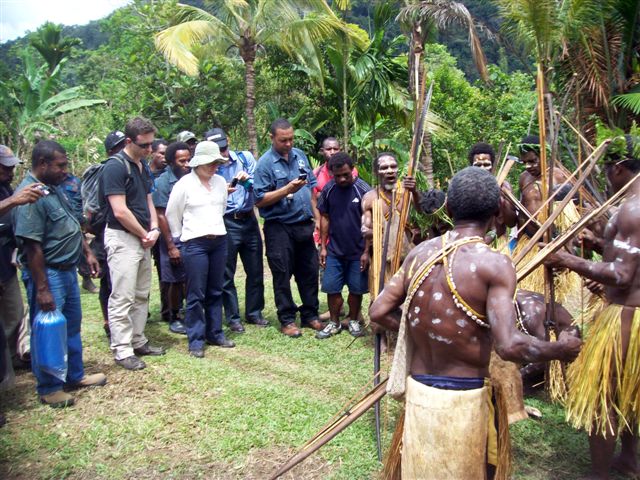
Tekadu villagers welcoming MPs Nolam and Basil to a fire-making demonstration
Walking the Bulldog Track is a chance to see a whole transect of PNG cultures and environments from chilly highlands, to the coastal swamps and rivers.
The walk takes you through the heart of the 1920s gold rush area at Edie Creek along a gravity-defying road built during WW11 to relieve Wau from the Japanese siege.
Nolam took the honors to deliver ducklings to Tekadu villagers under the Australian agriculture programme
 The highest point of the track is in primeval moss and rhododendron forests at 3, 000m with amazing views out to the Papuan coast and descends through the Eloa gorge, lined with hoop pine forests to the Lakekamu Basin, where nearly all the major species of fauna in PNG can be found in abundance.
The last part of the trip is a raft or canoe trip down the Tiveri and Lakekamu rivers to the Gulf.
At the moment this area isn't promoted well enough for its eco-tourism potential, which is as yet untapped.
Saying goodbye before taking on the Bulldog Track for Nukewa village in Malalaua, Gulf province
Last week, history was made when Bulolo MP Sam Basil took Queensland state minister for transport Rachael Nolam and Max Willies of Australian High Commission, plus a contingent made up of Bulolo level level government presidents, councilors and staff into Tekadu village along the Bulldog Track and eventually on to Gulf province and Port Moresby.
The team flew into Tekadu on Monday last week from Wau and after launching of flights, walked the Bulldog and traveled by dinghy downriver to Gulf province before ending up in Port Moresby.
The first flight into Tekadu after nine years was made possible by Bulolo joint district planning and budget priorities committee
Tekadu’s 600-plus people are part of the 12 tribes of Watut-speaking people also known as Kukukukus.
Being caught in between Bulolo electorate of Morobe province and Kerema electorate of Gulf province, the Tekadu people have not seen any air services for the past nine years, well, at least until last week.
“Other essential services are non-existent,” Basil recalls after completing the trek.
“Children growing up to be nine years old do not have any formal education and have not seen any planes landing at their rundown strip.
Sick passengers and buai traders loading their bags and boarding the plane for Bulolo airstrip
“Let us not forget the unfortunate children who have lost their lives through birth and other diseases.
“Like many other airstrips in Papua New Guinea, it is sad to see the Transport Minister Don Polye, who is also the Deputy Prime Minister, trying to spend K1.4 billion on Jackson Airport while neglecting such small rural airstrips.
“We are also seeing the same in health with Health Minister Sasa Zibe trying to spend K500 million on the Bautama City Super-Hospital while the rural health facilities are neglected.”
Tekadu culture on show
Basil, in his visit to Tekadu, urged the government to properly allocate the 2011 budget including the 2010 budget surpluses (K800 million-plus) estimated to be totaling over K10 billion, to rebuild aging infrastructure such as rural airstrips, national highways, rural health services, and district road systems to make the lives of rural dwellers easy because they make up over 85% of PNG’s population.
“Almost 90% of Members of Parliament represent rural electorates one way or another and must have rural people included in all their planning,” he adds.
“The Bulolo district joint district planning and budget priorities committee (JDP and BPC) in Dec 2009 installed a VSAT communication apparatus in Tekadu which has opened up communications in and out of Tekadu for almost a year now.
Nolam and Basil with ducks for Tekadu villagers
“The reestablishment of air services through North Coast Aviation (NCA) is just a follow-up service to complement the communication installation.
“Revival of essential services will automatically ride on those two very-important services: communication and transportation.
“A charter was negotiated and paid for a trip every month at the cost of K110, 000.
“The inbound flights will bring in government workers, building materials and medicine while return flights will carry sick and pregnant mothers, as well as buai (betelnut) bags.
“It is estimated that 600 to 700kg of buai can fetch close to K6, 000-7, 000 for those rural farmers.
Buai is the only cash crop in the Tekadu while alluvial gold panning is in its infancy stages.”
Accessing Bulolo and Wau from Tekadu is very hard compared to using the Bulldog Track for Port Moresby.
Its takes almost a whole day’s walk into Nukewa followed by dinghy or dugout canoe trip from Nukewa into Malalaua the next day, then a PMV into Port Moresby if they are lucky, or wait another day so it takes about three days in total.
The costs are K100 boat fare and K60 PMV fare, totalling K160 one way or K320 both ways per person.
So the buai they sell must recoup the fares and pay for porters.
The launching was well attended by all on Monday, Oct 18, while the team took the Bulldog Track the next day.
Bulolo district administration was represented by the Wau rural LLG manager Judy Pokana, Mumeng LLG manager Amon and Waria LLG manager.
LLG presidents included Wau Rural LLG’ John Yawa, Mumeng LLG’s Mathias Phillip, and Buang LLG’s Steven Sep while Waria was represented by its deputy president.
The Bulolo team, including the MP, used the walk to see for themselves the hardship and the obstacles the locals encounter while also collecting data for headquarters in Bulolo upon their return.
On the way in a dug out canoe
“The people of the Gulf village, Nukewa, had a brief meeting with me and reminded me that I was the first MP to trek into their village,” Basil says.
“They told me of their lack of services and asked me to help revive them.
“I reminded them that I am the MP representing Bulolo electorate and would bring their concerns to their local Kerema MP, Pitom Bombom.
“I will, in fact, invite him and will accompany him there to also address the Bulolo people’s concerns in relation to the usage of the track and share some responsibilities for the wellbeing of Bulolo travellers.
“The trip from Nukewa took nine hours along the river system and another five hours into Port Moresby, with a press conference and tour of Parliament House.
“I housed half of the Bulolo team while the other half was accommodated in a guest house in Port Moresby.
“The team returned into back into the electorate on Friday, Oct 22.”

Sunday, October 24, 2010

Reviving Tekadu’s transport and communication services


By SAM BASIL
Bulolo MP

Tekadu villagers welcoming MPs Basil and  Nolam to a fire-making demonstration.
Tekadu’s 600-plus people are part of the 12 tribes of Watut-speaking people also known as Kukukus.
They do not really know where their hearts lies when deciding on which electorate they belong to.
Being caught in between Bulolo electorate of Morobe province and Kerema electorate of Gulf province, the Tekadu people have not seen any air services for the past nine years.
Other essential services are non-existent.
Children growing up to be nine years old do not have any formal education and have not see any planes landing at their rundown strip.
Let us not forget the unfortunate children who have lost their lives through birth and other diseases.
Like many other airstrips in Papua New Guinea, it is sad to see the Transport Minister Don Polye, who is also the Deputy Prime Minister, trying to spend K1.4 billion on Jacksons Airport while neglecting such small rural airstrips.
We are also seeing the same in health with Health Minister Sasa Zibe trying to spend K500 million on the Bautama City Super-Hospital while the rural health facilities are neglected.
In my visit to Tekadu last week, I asked the government to properly allocate the 2011 budget including the 2010 budget surpluses (K800m-plus) estimated to be totaling over K10b, to rebuild aging infrastructures such as rural airstrips, national highways, rural health services, and district road systems to make the lives of rural dwellers easy because they make up over 85% of PNG’s population.
Almost 90% of Members of Parliament represents rural electorates one way or another and must have rural people included in all their planning.
The Bulolo district joint district planning and budget priorities committee (JDP&BPC) in December 2009 installed a VSAT communication apparatus in Tekadu which has opened up communications in and out of Tekadu for almost a year now.
The reestablishment of air services through North Coast Aviation (NCA) is just a follow-up service to complement the communication installation.
Revival of essential services will automatically ride on those two very-important services: communication and transportation.
A charter was negotiated and paid for a trip every month at the cost of K110, 000.
The inbound flights will bring in government workers, building materials and medicine while return flights will carry sick and pregnant mothers, as well as buai (betelnut) bags.
It is estimated that 600 to 700kg of buai can fetch close to K6, 000-7, 000 for those rural farmers.
 Buai is the only cash crop in the Tekadu while alluvial gold panning is in its infancy stages.
Accessing Bulolo and Wau from Tekadu is very hard compared to using the Bulldog Trail for Port Moresby.
Its takes almost a whole day’s walk into Nukewa followed by dinghy or dugout canoe  trip from Nukewa into Malalaua the next day, then a PMV into Port Moresby if they are lucky, or wait another day so its takes about three days in total.
The costs are as follow K100 boat fare K60 PMV far, totalling K160 one way or K320 both ways per person.
So the buai they sell must recoup the fares and pay for porters.
The launching was well attended by all on Monday, Oct 18, while the team took the Bulldog Trail the next day.
The team was accompanied by Queensland State Minister for Transport Rachael Nolam and Max Willies of Australian High Commission.
 Nolam took the honors to deliver ducklings to Tekadu villagers under the agriculture programme
Bulolo district administration was represented by the Wau rural LLG manager Judy Pokana, Mumeng LLG manager Amon and Waria LLG manager.
LLG presidents included Wau Rural LLG’ John Yawa, Mumeng LLG’s Mathias Phillip, and Buang LLG’s Steven Sep while Waria was represented by its deputy president.
The Bulolo team, including the MP, used the walk to see for themselves the hardship and the obstacles the locals encounter while also collecting data for headquarters in Bulolo upon their return.
The people of the Gulf village, Nukewa, had a brief meeting with me and reminded me that I was the first MP to trek into their village.
They told me of their lack of services and asked me to help revived them.
I reminded them that I am the MP representing Bulolo electorate and would bring their concerns to their local Kerema MP, Pitom Bombom.
I will, in fact, invite him and will accompany him there to also address the Bulolo people’s concerns in relation to the usage of the track and share some responsibilities for the wellbeing of Bulolo travellers.
Saying goodbye before taking on the Bulldog Trail for Nukewa village,  Malalaua, Gulf province
The trip from Nukewa took nine hours along the river system and another five hours into Port Moresby, with a press conference and tour of Parliament House.
I housed half of the Bulolo team while the other half was accommodated in a guest house in Port Moresby.
The team returned into back into the electorate on Friday, Oct 22.