Showing posts with label wau/bulolo. Show all posts

Sunday, November 7, 2010

Arrows of Eldorado – how the Wau-Bulolo gold rush all began

By MALUM NALU

It’s a sense of déjà vu to be in the historic mining towns of Wau and Bulolo in the Morobe province right now.
Merri Creek near junction with Edie Creek,1928
With the Hidden Valley gold mine project having been officially commissioned in September this year, exploration work at Wafi going ahead as scheduled, and PNG Forest Products continuing to supply its products to major projects around Papua New Guinea, things are certainly looking very good.
This is despite the dark cloud of the ethnic conflict between the local people and Sepik settlers hovering over,
History is indeed being rewritten in this Eldorado of PNG, which laid the foundation for today’s modern economy – and that of neighbouring Australia as well.
Harry Darby (seated) with pans of gold,1928
 Wau and Bulolo made miners from all over the world very rich men.
PNG Forest Products evolved from Bulolo Gold Dredging Limited that commenced operations in large-scale alluvial mining in the late 1920’s.
The Bulolo region was at the time one of the largest gold fields in the world.
A total of seven dredges scoured the valley floor, dredging thousands of tonnes of high grade gold-bearing ore.
How the Wau-Bulolo gold rush all began is a classic in itself and to go into every detail would fill many pages.
In the early part of last century, it was almost as if bowmen were guarding the gold that lay on the edge of their country more richly than anywhere else in the whole Pacific.
Fierce fighters lived along the Markham, the big river flowing into the Huon Gulf.
The Markham’s big tributary we call the Watut – and that was the river that led to the new gold, the new Eldorado.
The story is that Watut gold was discovered by an Austrian prospector, Wilhelm Dammkohler, and that he was killed by the Kukukukus on Sept 12, 1909, while prospecting with a companion Rudolph Oldorp
Canadian prospector Arthur Darling, in 1910, apparently did go up the Watut and into its tributary, the Bulolo.
There he found gold, rich gold
However, Darling and his team of Orokaiva boys were attacked by the local tribemen and had to exit.
“Precisely how far Darling traveled is unknown, though many old Papuan miners believed that he discovered gold,” according to the newly-released book Not A  Poor Man’s Field.
“Later events suggest he reached Koranga Creek, a tributary of the upper Bulolo River, itself a tributary of the Watut, and close to Kukukuku territory.”
Jensen’s bridge across the Bulolo, Guinea Gold workings,1928

When Darling recovered he went across to the new Lakekamu goldfield to try to win enough gold to outfit himself again.
On the Lakekamu field Darling spent a lot of time talking and mapping and planning with William Park, who was called ‘Sharkeye’.
Darling was at Samarai preparing to go up the Waria, when he collapsed, and soon afterwards died.
He had left Sharkeye Park knowing enough.
Somewhere right up the Watut was the source of gold that coloured the sands of the lower Markham, and the way to reach it was not to go right around by the rivers but to cut in overland from the coast!                                                                                                                                                                                                                                                                                                                                                                                                                                                                                                                                                                                                                                                                                                                                                                                                                                                                                                                                                                                                                                                                                                                                                                                                                                                                                                                                                     However, it was a foreign country, and although the Governor, Hahl, the best of the German administrators, did (about 1910) actually encourage Australian prospectors to come in and apply for permits to prospect, a man still needed more gold than Sharkeye had, to outfit himself for a months-long trip.
Before he had enough gold the war with Germany came.
It was a war that ended German rule in north-east New Guinea and the Bismarck Archipelago in six weeks, with little shooting.
When the military administration ended and the Australian Mandate started, in May 1921, Sharkeye Park was already going in and out of Morobe on the New Guinea side.
Now he headed up the Francisco River, looking for a way, through a mountain range that peaks up to nearly 10,000 feet, to the rivers that flowed on the other side.
He came back sick, broke, and not knowing what to do next time…
William Park was called ‘Sharkeye’ because he had a twist or a squint in one eye.
Park was born in Dorset, England, in 1871 and had been a gold miner in the Klondyke and in Western Australian before arriving in Papua around 1905.
“He was hard-faced and in his 50s, could ‘work like a tiger’, was jungle-wise and native-wise, hated to owe a penny, had more bouts of fever that he could count, suffered from piles, had his last tooth removed by Jack Nettleton, drank anything, and although it is untrue to say that he never wore boots, he often worked without them (he died, a very rich man, in Vancouver in 1940),” writes author Colin Simpson in Plumes and Arrows.
“In 1922 he needed a partner for two good reasons: he was broke and he had lost his permit to employ native labour when he flung a whiskey bottle out of his tent and it struck a native on the head and killed him.
“He was staying with Jack Nettleton, who had a trade store on the coast and was good to Park, and who had some money and a permit to work natives.
“Park told Nettleton what he knew.
“Nettleton, an English-born rover who had been everything from a salmon-fisher in Canada to a freight-clerk in New York, by way of jobs in Seattle, in Portland (Oregon) and Idaho, had stayed on in New Guinea after being a warrant-officer in the army during the war.
“In August 1922 Park and Nettleton struck inland and crossed the heavily jungled rivers of the Kuper Range beyond which lay the Bulolo River, forking off the Watut, and more gold, fantastically more gold, than anywhere else in Papua or New Guinea,
“They found it where Koranga Creek and Edie Creek come into Bulolo – gold that was to give them each a fortune; and when they had taken all they wanted, there was enough left for the six-million-dollar company, Bulolo Gold Dredging Ltd, to win, in the 30 years following, 56 tonnes of gold, then worth 28 million pounds.”
This was October 1922 and according to new issue Australian mining ordinances no claims could be worked until April 1, 1923.
April came and soon the richest parts of the Bulolo River were locked up in leases granted to the first-comers, including Morobe district officer Cecil J. Levien.
April 1923 came, and soon the richest parts of the Bulolo River were locked up in leases granted to the first-comers, including Levien.
Late arrivals had to look elsewhere.
“This is what Bill (W.G.) Royal and Dick (R.M.) Glasson were doing in 1926, trying to find the source of the Bulolo’s gold, when they came into Edie Creek and decided to go to the head of it,” Simpson writes.
“What showed in the dishes they panned in these streams was gold in unbelievable concentration – if it was gold.
“At first glance – according to Bill Money, who was in partnership with Royal, Glasson, F. Chisholm and Joe Sloane – it looked too dark.
“The Edie gold, alloyed with silver, was heavily stained with manganese but rubbed shiny and was the real stuff of Eldorado.
“Joe Sloane said to his mate who was running his sluice box at 11.30am: ‘Y’d better clean up Bill. The bloody gold’s running outa the box’.
“That day they got 272 ounces.
“Where the Bulolo was rich big-scale dredging, this was incredibly smaller-scale sluicing.
“About six million pounds worth of gold was won from the top of Edie Creek.
“The Edie ‘Big Six’ – Bill Money, Bill Royal, Dick Glasson, Frank Chisholm, Joe Sloane and Albert Royal – all became rich men.”
More and more white miners came and, again, the late-comers had to look elsewhere.
There was gold in the Watut as well as in the Bulolo.
Where was the source of the Watut’s gold?
Men who dreamed of finding another Edie Creek began to look for it.
They began to look for it on the other side of the Watut.

Sunday, October 24, 2010

Reviving Tekadu’s transport and communication services


By SAM BASIL
Bulolo MP

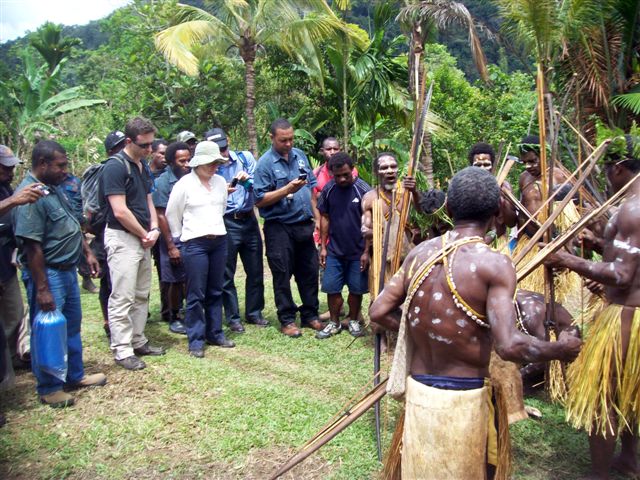
Tekadu villagers welcoming MPs Basil and  Nolam to a fire-making demonstration.
Tekadu’s 600-plus people are part of the 12 tribes of Watut-speaking people also known as Kukukus.
They do not really know where their hearts lies when deciding on which electorate they belong to.
Being caught in between Bulolo electorate of Morobe province and Kerema electorate of Gulf province, the Tekadu people have not seen any air services for the past nine years.
Other essential services are non-existent.
Children growing up to be nine years old do not have any formal education and have not see any planes landing at their rundown strip.
Let us not forget the unfortunate children who have lost their lives through birth and other diseases.
Like many other airstrips in Papua New Guinea, it is sad to see the Transport Minister Don Polye, who is also the Deputy Prime Minister, trying to spend K1.4 billion on Jacksons Airport while neglecting such small rural airstrips.
We are also seeing the same in health with Health Minister Sasa Zibe trying to spend K500 million on the Bautama City Super-Hospital while the rural health facilities are neglected.
In my visit to Tekadu last week, I asked the government to properly allocate the 2011 budget including the 2010 budget surpluses (K800m-plus) estimated to be totaling over K10b, to rebuild aging infrastructures such as rural airstrips, national highways, rural health services, and district road systems to make the lives of rural dwellers easy because they make up over 85% of PNG’s population.
Almost 90% of Members of Parliament represents rural electorates one way or another and must have rural people included in all their planning.
The Bulolo district joint district planning and budget priorities committee (JDP&BPC) in December 2009 installed a VSAT communication apparatus in Tekadu which has opened up communications in and out of Tekadu for almost a year now.
The reestablishment of air services through North Coast Aviation (NCA) is just a follow-up service to complement the communication installation.
Revival of essential services will automatically ride on those two very-important services: communication and transportation.
A charter was negotiated and paid for a trip every month at the cost of K110, 000.
The inbound flights will bring in government workers, building materials and medicine while return flights will carry sick and pregnant mothers, as well as buai (betelnut) bags.
It is estimated that 600 to 700kg of buai can fetch close to K6, 000-7, 000 for those rural farmers.
 Buai is the only cash crop in the Tekadu while alluvial gold panning is in its infancy stages.
Accessing Bulolo and Wau from Tekadu is very hard compared to using the Bulldog Trail for Port Moresby.
Its takes almost a whole day’s walk into Nukewa followed by dinghy or dugout canoe  trip from Nukewa into Malalaua the next day, then a PMV into Port Moresby if they are lucky, or wait another day so its takes about three days in total.
The costs are as follow K100 boat fare K60 PMV far, totalling K160 one way or K320 both ways per person.
So the buai they sell must recoup the fares and pay for porters.
The launching was well attended by all on Monday, Oct 18, while the team took the Bulldog Trail the next day.
The team was accompanied by Queensland State Minister for Transport Rachael Nolam and Max Willies of Australian High Commission.
 Nolam took the honors to deliver ducklings to Tekadu villagers under the agriculture programme
Bulolo district administration was represented by the Wau rural LLG manager Judy Pokana, Mumeng LLG manager Amon and Waria LLG manager.
LLG presidents included Wau Rural LLG’ John Yawa, Mumeng LLG’s Mathias Phillip, and Buang LLG’s Steven Sep while Waria was represented by its deputy president.
The Bulolo team, including the MP, used the walk to see for themselves the hardship and the obstacles the locals encounter while also collecting data for headquarters in Bulolo upon their return.
The people of the Gulf village, Nukewa, had a brief meeting with me and reminded me that I was the first MP to trek into their village.
They told me of their lack of services and asked me to help revived them.
I reminded them that I am the MP representing Bulolo electorate and would bring their concerns to their local Kerema MP, Pitom Bombom.
I will, in fact, invite him and will accompany him there to also address the Bulolo people’s concerns in relation to the usage of the track and share some responsibilities for the wellbeing of Bulolo travellers.
Saying goodbye before taking on the Bulldog Trail for Nukewa village,  Malalaua, Gulf province
The trip from Nukewa took nine hours along the river system and another five hours into Port Moresby, with a press conference and tour of Parliament House.
I housed half of the Bulolo team while the other half was accommodated in a guest house in Port Moresby.
The team returned into back into the electorate on Friday, Oct 22.

Wednesday, October 20, 2010

Queensland state minister visits Bulolo

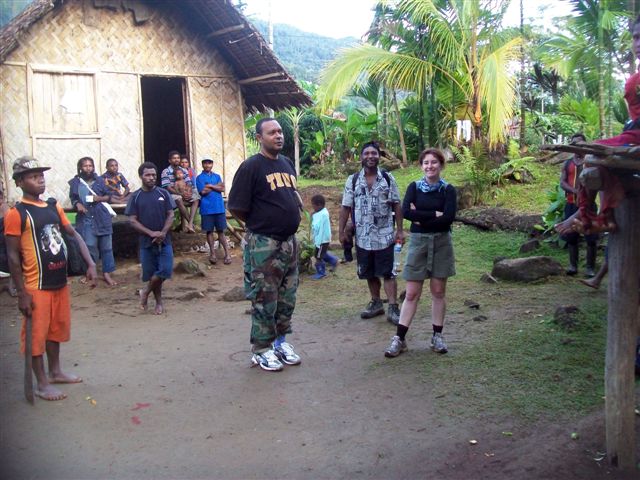
Rachael Nolan meeting a young girl in Bulolo
Queensland State Minister for Transport Rachael Nolan is on vacation visiting the Bulolo Electorate accompanied by Bulolo MP Sam Basil.
The event started last Friday when the book, Not a Poor Man's Field, was launched at 5pm in Crowne Plaza Hotel just as Nolan arrived into the country for the first time.
An early flight into Lae last Saturday saw the team having breakfast with some Morobe MPs and Morobe administration representatives.
These included Lae MP Bart Philemon Tewai-Siassi MP Vincent Michaels while others sent their apologies.
A quick visit into the Rainforest Habitat situated inside University of Technology campus saw the visiting team amazed with the bird collection.
A ‘Welcome to Bulolo’ billboard was officially unveiled by Nolam along the Warabumg area bothering the Huon Gulf electorate while occasional stops occurred along the way for the locals, who presented flowers and bilums to the minister and her team.
The billboard which was unveiled by Nolam
The Buang singsing group welcomed the party at Basil’s residence in Segayo village. Nolam was very impressed by the traditions, the different geographical surroundings and the wonderful people.
Early last Sunday morning, Nolam and her team visited the Buang limestone caves and the burial site which contains bones and some mummified bodies and later drove to the Hidden Valley min e.
The team overnighted in Wau to do the Bulldog Track into Kerema on Monday.
 Nolam and her team will use the trip as trekkers, while Basil and his administration team, including some of his joint district planning and budget priorities committee (JDP&BPC) members will use the trip as a fact-finding mission.
They will asses the impact of the bothering wards of Wau Rural local level government (LLG) of Morobe and the Kerema open in the Gulf province, which normally have easier access into Port Moresby then to Wau, Bulolo or Lae.
Nolam will take the honors in Tekadu to unveil the 12 months pre-paid charter flight from the North Coast Aviation paid for by the Bulolo District JDP&BPC at the cost of more then K100, 000.
This will see a second project initiated in the area after the installation of VSAT in Tekadu late last year which has opened up communication to the outside world.
The Tekadu airstrip is now prepared by the people themselves and ready to take airplanes back into Tekadu.
Tekadu has the highest production of buai and with the air charters it is estimated that over K6, 000 of buai trade will be opened up for the locals directly into Lae while other supplies like medical, school supplies and regular visits by the administration will be connected directly through the air charter directly into Tekadu.
Basil is strongly looking at a proposal to help pay for a new aircraft with North Coast Aviation and have all airfares and freight into Waria and Tekadu subsidised at a rate of 50%.
Negotiations are still taking place with the Bulolo MP is urging other Morobe MPs whose areas depend on air transport to be part of this proposed project.

Sunday, October 17, 2010

New book tells story of Wau/Bulolo goldrush

Michael Waterhouse showing a copy of his book at the Crowne Plaza in Port Moresby today.-Nationalpic by MALUM NALU


By MALUM NALU
 
A spectacular new history book on the history of the famous Wau/Bulolo goldfields of Morobe province was launched at the Crowne Plaza in Port Moresby last Friday.
Guests included Bulolo MP Sam Basil, mining and business leaders and many more.
Not A Poor Man’s Field, by Australian Michael Waterhouse, explores Australia’s colonial experience in New Guinea before World War 11 – a unique but little-known period in the history of both countries.
Waterhouse has close family ties to the pre-war goldfields, his grandfather Leslie Waterhouse having been a pivotal player in their development, as a director of the largest gold-mining company, Bulolo Gold Dredging, and the biggest airline, Guinea Airways.
First copies are on sale at the University of PNG Bookshop.
Waterhouse and his wife came to Port Moresby on Oct 4, overnight, and then traveled on to the fabled Morobe gold towns of Lae, Wau, Bulolo and Salamaua before returning to Port Moresby for the book launch.
He tells The National that Not A Poor Man’s Field is not simply another “white man’s history”.
“For the record,” Waterhouse says, “while the sub-title refers to it being an ‘Australian colonial history’, this is because the main market is in Australia and the book has to be positioned as ‘Australian history’ to be commercially-viable.
“However, I’ve gone to considerable lengths to bring a New Guineans perspective to the history.
“This is not simply another ‘white man’s history’.
“I do feel strongly about this – it is your country’s history as well, and I’ll make this point at every opportunity.”
Not A Poor Man’s Field is a dramatic account of small miners, an extraordinarily-rich gold discovery, visionaries and the construction of giant dredges, power stations and townships in a remote jungle area
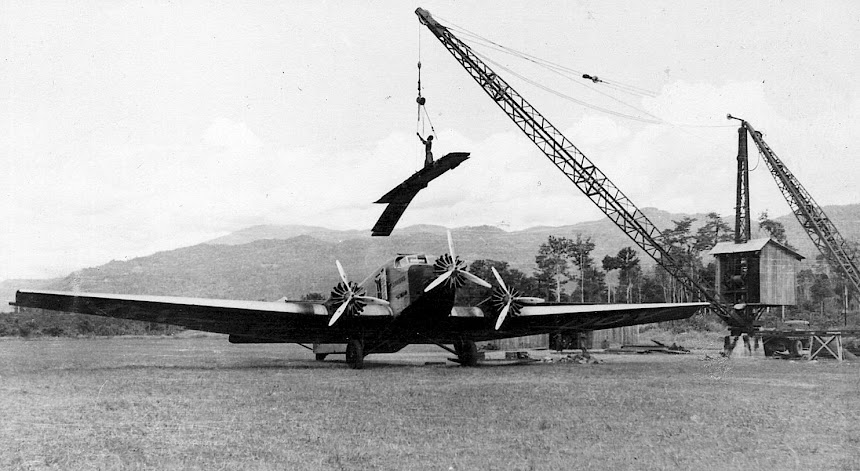
It is also the story of how risk-taking pilots, flying aeroplanes ranging from single-engine plywood biplanes to large Junkers G31 freighters, opened up an otherwise-impenetrable country.
New Guinea led the world in commercial aviation throughout the 1930s; world records were often set and as often broken.
The book discusses early encounters between villagers and Europeans from both white and black perspectives, as well as the indentured labour system which drew New Guineans to the goldfields from all over the country.
Other themes include the camaraderie of white settlers in an alien environment, race relations in a colonial society, the ineffectiveness of Australia’s administration of New Guinea under a League of Nations mandate and the Japanese invasion and its consequences.
The book takes a multi-disciplinary approach, analysing the colonial experience from economic, social, ethnographic and political/administrative perspectives.
Not A Poor Man’s Field takes its name from the Administrator of New Guinea, Brigadier General Evan Wisdom, who when trying to discourage Australians rushing to the goldfields in 1926, wrote: “A poor man’s field in Australia is understood to be a field to which a man without anything can go with his swag and live by the gold he gets from the field; he is not dependent on anyone helping him.
“He can go out with a swag and a tin of ‘dog’ and get enough gold to keep him going.
“But you must have natives here to help you, and money to pay them, money to carry you there, and on when you get there; therefore it is not a poor man’s field.”
Waterhouse hopes his book will encourage academics in both countries to embark on further research into, and help develop a broader understanding of the history of the Australia-PNG relationship.
Waterhouse has recreated a period that has been largely obscured by time and the destruction of records during WW11.
In doing so, he has drawn on diverse and often unexpected source, with insights gained from studies in anthropology at Sydney University and in economics and economic history at the Australian National University.
His experience in senior positions with government (the Commonwealth Treasury) and in business (with Westpac and as a consultant) has also enabled him to explore the commercial, financial and government dimensions in depth.